How Do Manual Roller Shutters Work? Parts & Operation
If you’ve ever pulled a strap to raise a roller shutter and wondered what’s actually happening behind the guide rails, you’re not alone. Understanding how do manual roller shutters work gives you a real advantage, not just as general knowledge, but because it helps you spot problems early, communicate clearly with a technician, and even handle basic troubleshooting yourself. At Roller Shutter Repairs Adelaide, we’ve spent over 20 years working on these systems across homes and businesses throughout Adelaide, and we can tell you that most repair calls start with a part the owner didn’t know existed until it failed.
Manual roller shutters are mechanically straightforward, but they rely on several components working together in a specific way. The strap, the winder box, the barrel, the slat curtain, the spring mechanism, each one plays a defined role in raising and lowering the shutter smoothly. When even one of these parts wears out or falls out of alignment, the whole system can jam, stick, or stop working altogether. Knowing what each piece does helps you understand why things go wrong and what kind of repair you’re actually looking at.
This article breaks down every major component of a manual roller shutter, explains how the operating mechanism functions step by step, and covers the most common points of failure. Whether you’re a homeowner trying to figure out why your shutter won’t retract or you’re simply curious about the mechanics, you’ll walk away with a clear picture of how the entire system works, from the strap in your hand to the barrel above the window.
Why manual roller shutters still matter
Electric roller shutters get most of the attention these days, but manual roller shutters remain a choice across a large portion of Adelaide homes and commercial properties. They don’t rely on a motor, a power supply, or a remote control and no dependency on electricity to open your shopfront or secure your windows. For anyone asking how do manual roller shutters work, the answer starts with understanding why people still choose them and why the technology remains genuinely practical rather than simply outdated.
Manual roller shutters account for a large proportion of old type installations across residential Adelaide, particularly in older homes and smaller commercial premises, precisely because their simplicity was a strength, not a limitation.
The cost advantage over electric systems
Upfront installation costs for manual shutters run lower than motorised alternatives, and that gap widens when you factor in long-term maintenance. A motorised system adds a motor, wiring, possibly a remote hardware to the equation. Each of those components can fail independently. With a manual system, the mechanical parts are simpler, cheaper to source, and faster to replace, which matters when you’re dealing with a faulty shutter on a business premises first thing on a Monday morning. However keep in mind, product quality always plays a factor in all of the above. If a manual shutter is not installed right , it could fail, if its to heavy for the winder, it could fail. Quality motors should last you up to 20 years.
Where manual shutters outperform electric ones
There are specific situations where a manual roller shutter is the more reliable choice, not just the more affordable one. Power outages are the clearest example. When electricity goes out, a motorised shutter without a manual override or a UPS or a battery leaves you either locked in or locked out. A manual shutter keeps working regardless of what the grid is doing. In areas prone to storm-related outages, which Adelaide experiences during severe summer weather, that reliability carries practical weight.
Manual shutters also suit locations where a power connection to the shutter housing isn’t practical or cost-effective to install. Garden sheds, detached garages, small kiosks, and heritage buildings where running new cabling creates complications all benefit from a system that needs no electrical infrastructure at all.
What Adelaide conditions mean for manual shutters
Adelaide’s climate puts specific demands on any exterior building product. Hot, dry summers, occasional dust from northerly winds, and exposure to UV across most of the year all affect how roller shutter components age and perform. Manual shutters in this environment rely on physical contact between parts, including straps, guides, springs, and slats, so material quality and regular lubrication matter more here than in milder climates.
The Adelaide Hills and Barossa Valley regions add further variables. Properties in those areas deal with greater temperature swings between seasons, and shutters on exposed elevations face more UV and wind-driven grit than those in sheltered metropolitan suburbs. Understanding the mechanics of a manual system helps you recognise when those environmental factors are starting to affect performance, whether that’s a strap that’s fraying faster than expected or slats that sit unevenly in the guides after a hot summer.
Manual shutters aren’t a compromise. For the right property and the right application, they’re simply the most practical and dependable option available.
The main parts of a manual roller shutter
Every manual roller shutter is built from a set of distinct components, each with a specific job. Understanding what those parts are gives you a clear foundation for grasping how do manual roller shutters work as a complete system. When a shutter starts playing up, the fault almost always traces back to one of these components, and knowing what you’re looking at makes it far easier to describe the problem to a technician or identify what needs attention before it gets worse.
The slat curtain, barrel, and guide rails
The slat curtain is the visible face of the shutter, made up of interlocking aluminium or steel slats that link together in a continuous strip. Each slat connects to the one above and below it, allowing the curtain to flex as it rolls up or lowers. The slats ride inside two vertical guide rails fixed to each side of the opening, which keep the curtain aligned and stop it from bowing outward under wind pressure. Without straight, undamaged guide rails, the curtain will bind, wobble, or jump out of track entirely.
The barrel sits horizontally above the opening and acts as the core around which the entire slat curtain coils when the shutter opens.
Positioned inside the hood, the barrel is typically a steel or aluminium tube, and its diameter determines how tightly the curtain coils and how many rotations the system needs to fully retract. A correctly sized barrel keeps the curtain compact in the hood and reduces strain on the operating mechanism over thousands of cycles.
The spring mechanism, bottom rail, and hood
The spring sits inside the barrel and stores mechanical energy as you lower the shutter. That stored tension counterbalances the weight of the curtain when you raise it, which is why a well-tensioned spring makes the shutter feel lighter to operate than its actual weight suggests. When the spring loses tension or breaks, the curtain suddenly feels far heavier to lift and can drop faster than it should when lowering.
Reinforcing the base of the curtain is the bottom rail, a thicker, stiffened slat that adds rigidity and gives you a surface to grip or push when operating the shutter by hand. Above everything sits the hood, a protective housing that covers the barrel, spring, and coiled curtain when the shutter is fully open, keeping weather, dust, and pests away from the mechanism.
Manual operating systems you will see in Adelaide
Not every manual roller shutter operates the same way. Three distinct mechanisms are commonly installed across Adelaide homes and businesses, and each works differently in terms of how you apply force and how that force transfers to the barrel. Knowing which system your shutter uses is the first step in understanding how do manual roller shutters work in practical terms, and it directly affects what kind of maintenance or repair each system needs.
The strap and winder box
The strap-and-winder combination is the most common manual system you’ll encounter in Adelaide residential properties. A flat webbing strap, usually made from polyester or nylon, feeds through a slot in the winder box mounted on the wall beside the opening. Pulling the strap downward rotates an internal drum inside the winder box, which in turn connects to the barrel and raises the curtain. Releasing the strap lets the spring tension in the barrel assist the controlled lowering of the curtain.
The strap is one of the highest-wear components in a manual shutter system, and inspecting it regularly for fraying or stiffness can prevent an unexpected failure.
Winder boxes vary in quality and load rating. Higher-load winder boxes suit wider or heavier curtains, while lighter-duty units work adequately on small windows. Using an undersized winder box on a large curtain puts excess stress on the strap and the internal drum, shortening the lifespan of both components considerably.
The crank handle system
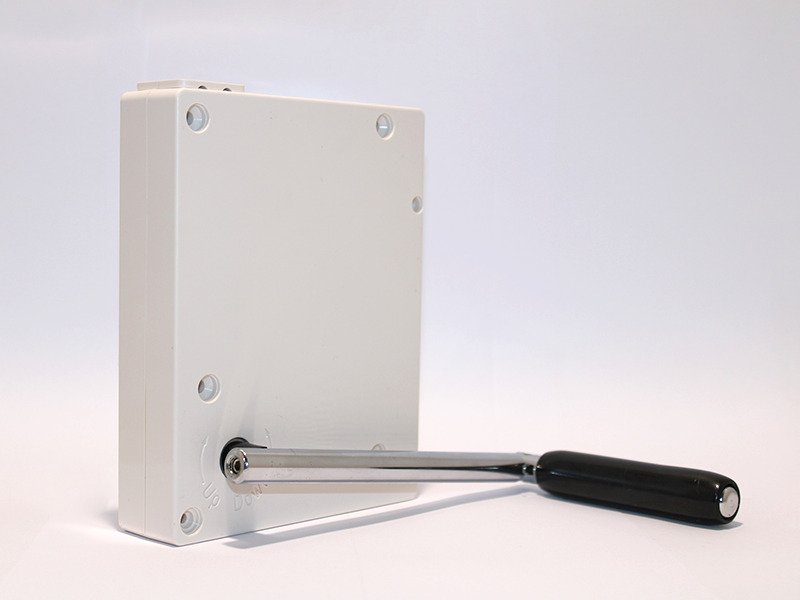
A crank handle, sometimes called a winder handle, suits situations where a strap is impractical, such as shutters positioned high on a wall or in commercial settings where operators prefer a more controlled mechanical action. You insert or rotate the handle at the side of the shutter housing, and the rotational motion feeds directly to the barrel mechanism through a geared connection. The gear ratio determines how much effort each turn requires relative to the weight of the curtain.
Common situations where a crank handle is the practical choice include:
- Commercial shopfronts with small curtains requiring steady control
- Properties where an electric or battery operated shutter are not suitable
The cord and pulley system
Cord-operated shutters use a looped or continuous cord running through a pulley mounted at the top of the guide rail. Pulling one side of the cord raises the curtain while the opposite side descends. These systems are less common in newer Adelaide installations but still appear regularly in older residential and light commercial properties. The cord material and pulley quality both affect how smoothly the system operates over years of daily use.
How a manual roller shutter lifts and lowers
When you pull the strap or turn the crank on a manual roller shutter, a specific mechanical sequence begins that transfers your effort through several components before the curtain actually moves. Understanding how do manual roller shutters work as a complete system means understanding that sequence clearly, because each stage depends on the one before it functioning correctly. Any break in that chain stops the operation entirely, whether the fault is a slipping winder drum or a spring that has lost its tension.
The sequence from strap pull to curtain rise
Pulling the strap downward rotates the drum inside the winder box. That rotation transfers directly to the barrel sitting inside the hood above the opening. As the barrel turns, it winds the slat curtain upward, coiling the slats around it in neat layers. The guide rails on each side keep the curtain tracking straight throughout the full travel from fully closed to fully open.
Each slat interlocks with the next, so the curtain behaves as one connected surface rather than a series of independent parts, which is why a single damaged slat can disrupt the movement of the entire curtain.
The winder box controls how much effort each pull requires relative to the weight of the curtain. A geared winder box converts slower, deliberate pulls into smooth, controlled barrel rotation, which suits heavier curtains (commercial only) and reduces strain on the strap over thousands of operating cycles.
What affects effort, smoothness and safety
Once you understand how do manual roller shutters work as a complete mechanical system, the next question becomes why some shutters operate effortlessly while others feel stiff, jerky, or unpredictable. Several factors directly influence how much effort you need to apply, how smoothly the curtain travels through the guides, and how safely the shutter operates during daily use. Getting these factors right means less physical strain on every operation and fewer repair calls over the life of the system.
Curtain weight and shutter size
The size and material of the slat curtain are the most immediate factors affecting how much effort each operation requires. A wider or taller curtain is heavier, and that weight determines how much spring tension is needed inside the barrel to create an effective counterbalance. Steel slats weigh noticeably more than aluminium ones of the same dimensions, so the operating mechanism on a steel-curtain shutter needs to be matched to the higher load from the point of installation.
Fitting a winder box or crank mechanism rated below the actual curtain weight is one of the most common causes of excessive operating effort and premature component wear.
Spring tension and calibration
The commercial spring inside the barrel must be correctly tensioned to suit the weight of the curtain it supports. Too little tension means you lift the near-full weight of the slats on every pull. Too much tension causes the curtain to spring upward aggressively when you release the strap, which creates a safety hazard and stresses the slat connections at the top of the curtain. A technician can adjust spring tension during a service visit, and getting it calibrated correctly makes a significant difference to how the system feels over years of use.
Guide rail alignment and lubrication
Straight, properly aligned guide rails allow the slat curtain to travel without binding or friction at the edges. If the rails twist, bow outward, or collect grit over time, the slats start to drag against the sides, which increases effort and can cause uneven wear on the slat edges. Regular lubrication with a silicone-based product applied to the guide rail channels reduces friction without attracting dust the way oil-based lubricants do. In Adelaide’s dry, dusty conditions particularly, this maintenance step keeps the curtain running cleanly and reduces strain on every component in the operating chain.
Common manual roller shutter problems and causes
Most faults in a manual roller shutter system follow predictable patterns, and once you understand how do manual roller shutters work as a mechanical chain, those patterns start to make sense. Problems rarely appear without a cause, and identifying the root issue early prevents what starts as a minor nuisance from turning into a full curtain replacement or structural damage to the guide rail housing.
Stiff or heavy operation
A shutter that suddenly feels harder to lift almost always points to one of three causes: a spring that has lost tension inside the barrel, insufficient lubrication in the guide rails, or a winder box that is wearing out internally. Over time, the spring inside the barrel fatigues and stops providing the counterbalance it was calibrated to deliver. You end up lifting closer to the full dead weight of the curtain on every operation, which strains your wrist and accelerates wear on the strap and drum simultaneously.
Grit accumulation in the guide rail channels is one of the most underestimated causes of heavy, uneven shutter operation in Adelaide’s dry climate.
Dried-out or contaminated guide rail channels increase friction across every slat edge as the curtain travels. Applying a silicone-based lubricant to the channels resolves friction-related stiffness quickly and costs very little compared to the component wear it prevents.
Curtain jams, sticks, or jumps off track
A curtain that binds mid-travel or exits the guide rail usually signals physical damage to one or more slats, a bent guide rail, or an obstruction inside the channel. Even a single slat with a buckled edge can catch on the rail and stop the whole curtain from moving cleanly. Bent guide rails are a common result of impact damage, whether from a vehicle, garden equipment, or a strong gust forcing an unsecured curtain outward.
Misalignment at the barrel end of the system can also cause the curtain to coil unevenly, creating a lopsided load on one guide rail that causes binding at the top of travel.
Strap fraying, snapping, or slipping
A strap that frays, snaps mid-pull, or slips inside the winder box is almost always a wear issue rather than a defect. Straps have a finite cycle life, and UV exposure in Adelaide accelerates the degradation of polyester webbing. A slipping strap inside the winder box points to internal drum wear or a strap that has stretched beyond the drum’s grip capacity, both of which require part replacement rather than adjustment.
Basic checks and safe fixes you can try
Before you call a technician, there are a few practical steps you can take yourself once you understand how do manual roller shutters work and which components are accessible without tools. Most of these checks take less than ten minutes and can resolve minor faults or at least confirm what needs professional attention before you commit to a repair call.
Check the guide rails and bottom rail
Start by examining both vertical guide rails from top to bottom, looking for any visible obstructions, bent sections, or accumulated grit inside the channels. Leaves, spider webs, and fine dust from northerly winds are common culprits in Adelaide properties, and clearing the channels by hand or with a dry cloth often restores smooth curtain travel immediately. Also check the bottom rail for warping or visible impact damage, as a bent bottom rail can prevent the curtain from seating correctly against the sill and disrupt the coiling action when you raise the shutter.
Never attempt to straighten a severely bent guide rail yourself, as forcing an already stressed rail can crack the housing or pull the fixing screws out of the wall.
Lubricate the moving parts
Apply a silicone-based spray lubricant to the inside channels of both guide rails and work the shutter up and down several times to distribute it evenly. Avoid WD-40 or petroleum-based products, as these attract dust and create a sticky residue over time that makes friction worse. Pay particular attention to the points where the slat edges contact the rail, as these are the highest-wear contact surfaces in the system and the most likely source of the binding you’re feeling.
Inspect and reset the strap
Look at the full length of the strap for fraying, thinning, or stiffness where it bends around the winder drum. A strap showing visible wear at the fold point needs replacing before it snaps during operation. If the strap feels slack or pulls without engaging the drum properly, check that it’s seated correctly inside the winder box slot rather than riding to one side, as an off-centre strap slips rather than grips. Reseating it correctly takes only a moment and can restore full engagement without any parts replacement. Replace the strap if you notice any of the following:
- Visible fraying or splitting along the edges or fold point
- Stiffness that stops it feeding smoothly through the winder slot
- Discolouration or cracking from UV exposure
Servicing and upgrades to keep shutters reliable – call the experts on 0414611662
Knowing how do manual roller shutters work gives you the foundation, but regular servicing is what keeps that knowledge useful rather than simply theoretical. Manual shutters are durable systems, yet they operate through constant mechanical contact between moving parts, and without periodic attention, wear accumulates quietly until something fails at the worst possible moment.
Annual servicing and what it covers
A professional service visit typically covers every component in the operating chain, from the spring tension inside the barrel through to the condition of the strap and winder box drum. A technician will check slat alignment, inspect the guide rail fixings, test spring balance, clean the channels, and apply the correct lubricant to all contact points. Catching a spring that is losing tension or a strap showing early fraying during a service prevents a complete failure that could leave a window unsecured or a shopfront stuck mid-travel.
Scheduling a service visit once a year covers most residential properties, while commercial shutters that operate multiple times daily benefit from a check every six months.
Most servicing visits also include a check of the bottom rail seal and the hood fixings, since loose fixings allow the hood to shift and misalign the barrel, which creates uneven coiling and added stress on one side of the curtain. Addressing these small issues during a planned visit costs a fraction of what an emergency repair call costs after a failure.
Upgrading from manual to electric operation – 0414611662 call us to help
Converting a manual roller shutter to motorised operation is a straightforward upgrade that a qualified technician can carry out without replacing the slat curtain, guide rails, or hood. The existing barrel is replaced or adapted to accept a tubular motor, and a control system, either switch-based or remote, is wired in. The mechanical components you already understand remain in place, and the motor simply takes over the job the strap or crank was doing.
This upgrade suits properties where the physical effort of daily operation has become a concern, or where the shutter is positioned in a location that makes manual operation awkward. The cost of conversion runs well below a full new electric installation because the bulk of the existing system stays intact, and the work can usually be completed in a single visit by an experienced technician.
Final thoughts
Understanding how do manual roller shutters work puts you in a far better position to maintain your system, spot early warning signs, and make informed decisions about repairs or upgrades. Every component, from the spring inside the barrel to the strap feeding through the winder box, plays a defined role in a mechanical chain that depends on all parts working together. When one element wears out, the effects ripple through the entire system, which is why catching problems early saves considerably more time and money than waiting for a complete failure.
If your shutter is feeling stiff, binding in the guides, or showing signs of wear you can’t resolve with basic maintenance, getting a professional assessment is the most practical next step. The team at Roller Shutter Repairs Adelaide has over 20 years of experience servicing manual and electric systems across Adelaide and surrounding regions, with no call-out fees and fast response times.